Reading Group Guide
A Boy Named Holl
by John Creedy
True history · 19 chapters in three parts · about 110 pages
About the book
In October 1886, a press telegram from Auckland told of castaways who had survived fifty-two days adrift in an open boat on the Pacific. It named five of the crew, “…and a boy named Hall”.
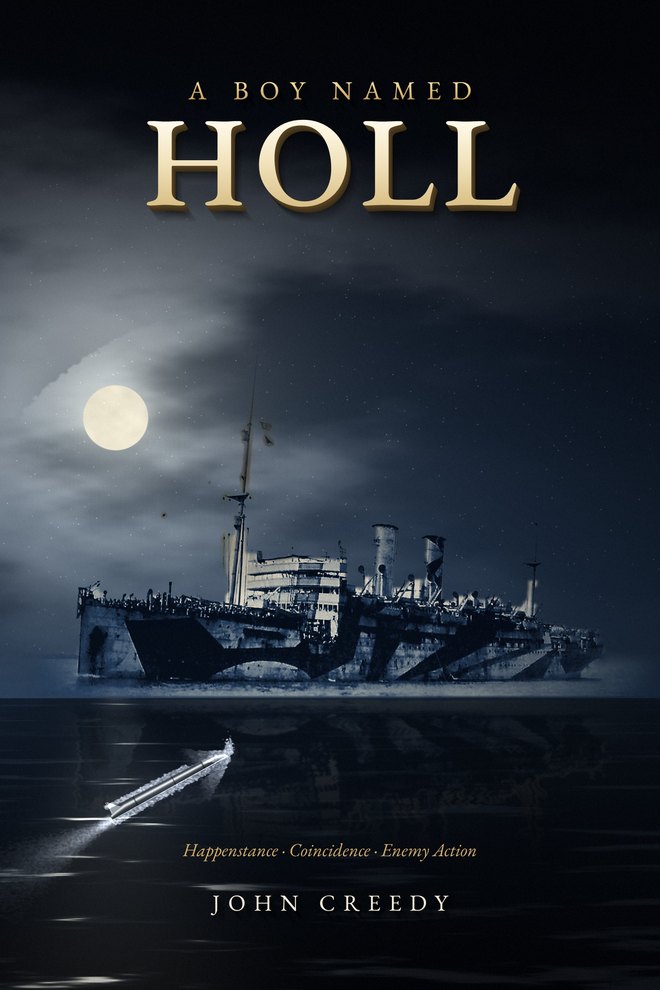
The boy was eighteen-year-old apprentice Edward John Holl. Thirty years later, as a Captain of the Union-Castle Line, he would face the sea’s cruelty twice more: aboard the hospital ship Gloucester Castle, torpedoed in the English Channel in 1917, and in command of the troopship Leasowe Castle, with three thousand men aboard, on a moonlit night in the Mediterranean in May 1918.
The book is built on Ian Fleming’s words: “Once is happenstance. Twice is coincidence. Three times is enemy action.” Its three parts follow those three events.
The true story behind the book
The book began in an attic. The author found a twelve-page letter written in 1918 by his grandfather, Lieutenant Norman Howard, then 22 and newly married, to his wife Dorothy. It told her he had survived the sinking of his troopship. Folded inside was a small dinner menu card with nine signatures on the back, signed in Alexandria two days after the sinking.
Following those names led back to the troopship’s Master, Captain Edward John Holl, and to his first shipwreck as an apprentice in 1886, which he had described in a letter home of his own. It also led forward. One signature belonged to Sub-Lieutenant George Hugh Jocelyn Evans, aged 19, praised at the naval enquiry for his part in the rescue. He later changed his name to Alan Hillgarth and, as British Naval Attaché in Madrid, worked alongside Ian Fleming’s naval intelligence colleagues on the famous wartime deception, Operation Mincemeat.
- 1886
- The cargo clipper Dunnottar Castle runs aground on Kure Atoll in the North Pacific. Apprentice Edward Holl and his shipmates sail an open boat for help.
- March 1917
- Captain Holl’s hospital ship Gloucester Castle, carrying nearly 400 sick and wounded, is torpedoed in the English Channel. He saves his passengers and his ship, and is awarded the Distinguished Service Cross.
- 27 May 1918
- The troopship Leasowe Castle, with around 3,000 aboard, is torpedoed in the Mediterranean.
Questions for discussion
The questions follow the book’s three parts. Some refer to events late in the story, so groups may prefer to use them once everyone has finished the book.
Part One · Dunnottar Castle (Happenstance)
- The book opens not in 1886 but at an officers’ dinner in Alexandria in 1918. Why do you think the author chose to begin there, and how did that opening shape the way you read young Edward’s story?
- A telegram named five of the crew “…and a boy named Hall”. What does that misspelt name say about how young seafarers were seen in their time, and how does the book give Edward back his name?
- In the open boat, Edward keeps a notebook wrapped in oilcloth and guards it as a treasure. Writing things down runs through the whole book: Edward’s letter home, Lieutenant Howard’s letter, the signed menu card. Why do these written records matter so much?
- One biscuit and a pint of water a day, discipline and friction in a crowded boat: which moments of leadership, or of strain between the men, stood out for you?
- “Do your utmost, they must be saved” gives Chapter 3 its title. Where do you see that idea return later in Edward’s life?
Part Two · HMHS Gloucester Castle (Coincidence)
- Chapter 8 asks whether the early years of the war were “a civilised war”. How did learning about the international rules protecting hospital ships, and the decision in 1917 to treat them as targets, affect you?
- Captain Holl brings every patient to safety and saves his ship as well. What does the book suggest made the difference, and what had 1886 taught him?
- Edward carries a handheld compass, which the book describes as “much the same as an arm on your shoulder when times are tough”. Which objects carry meaning in this story, and why?
Part Three · HMT Leasowe Castle (Enemy Action)
- Dazzle paint, a zigzag course and careful boat drills, and yet a bright full moon. How does the author build tension when the reader already knows a torpedo is coming?
- The “Eyewitness” chapter is told in Lieutenant Howard’s own words. How did reading a first-hand account compare with the narrated chapters? Which voices stayed with you?
- Nineteen-year-old Sub-Lieutenant Evans cuts the straining cables to save his ship. Did his later life as Alan Hillgarth surprise you? Does knowing what he went on to do change how you see that night?
- The last chapter belongs to Private Harry Jenkins, “one of three thousand”, rather than to the captain. Why do you think the author ended there?
The whole book
- “Once is happenstance. Twice is coincidence. Three times is enemy action.” Do you read the three events in Holl’s life as chance, coincidence or something more? Has the book changed how you think about coincidence?
- In the Preface, the author speaks of “a heavy burden of responsibility” to portray real people fairly, using imagination only where the records fall silent. Where should the line between history and storytelling lie?
- The book calls itself “a salute to young men” and to the merchant seafarers whose sacrifice is often overlooked. Did it change your view of the merchant navy’s part in the First World War?
- Holl’s working life spans the change from sail to steam. What does the book show about how quickly his world changed, at sea and in war?
- This story began with a letter found in an attic. Are there letters, photographs or stories in your own family that deserve to be told? How would you begin?
Going further
- Kure Atoll, the remote reef at the western end of the Hawaiian chain where Dunnottar Castle ran aground. Its Hawaiian name, Holaniku, means “Bringing forth Heaven”.
- Hospital ships and the Hague Conventions: the 1907 rules that made attacking a marked hospital ship a war crime.
- Dazzle camouflage: the bold painted patterns meant to confuse a submarine’s view of a ship’s course and speed.
- Operation Mincemeat (1943) and the life of Alan Hillgarth.
- The Union-Castle Line and Britain’s merchant seafarers in the First World War.
Getting copies
A Boy Named Holl is coming soon in paperback, hardback and Kindle. Each member can buy their own copy, and the links appear on the book’s page as soon as it is published.
You’re welcome to print and share this guide with your group. © 2026 Heaven Books.